

Messages
The Messages page allows you to view all messages previously sent on your OptiPub installation. Messages are automatically organized into the following sections:
| Status | Description |
|---|---|
| Sent | Messages that have been delivered to segments. |
| Scheduled | Messages with a future send time. You can edit or cancel them before they send. |
| Tests | Messages sent to test email addresses instead of segments. |
| Canceled | Scheduled messages that were canceled before sending. |
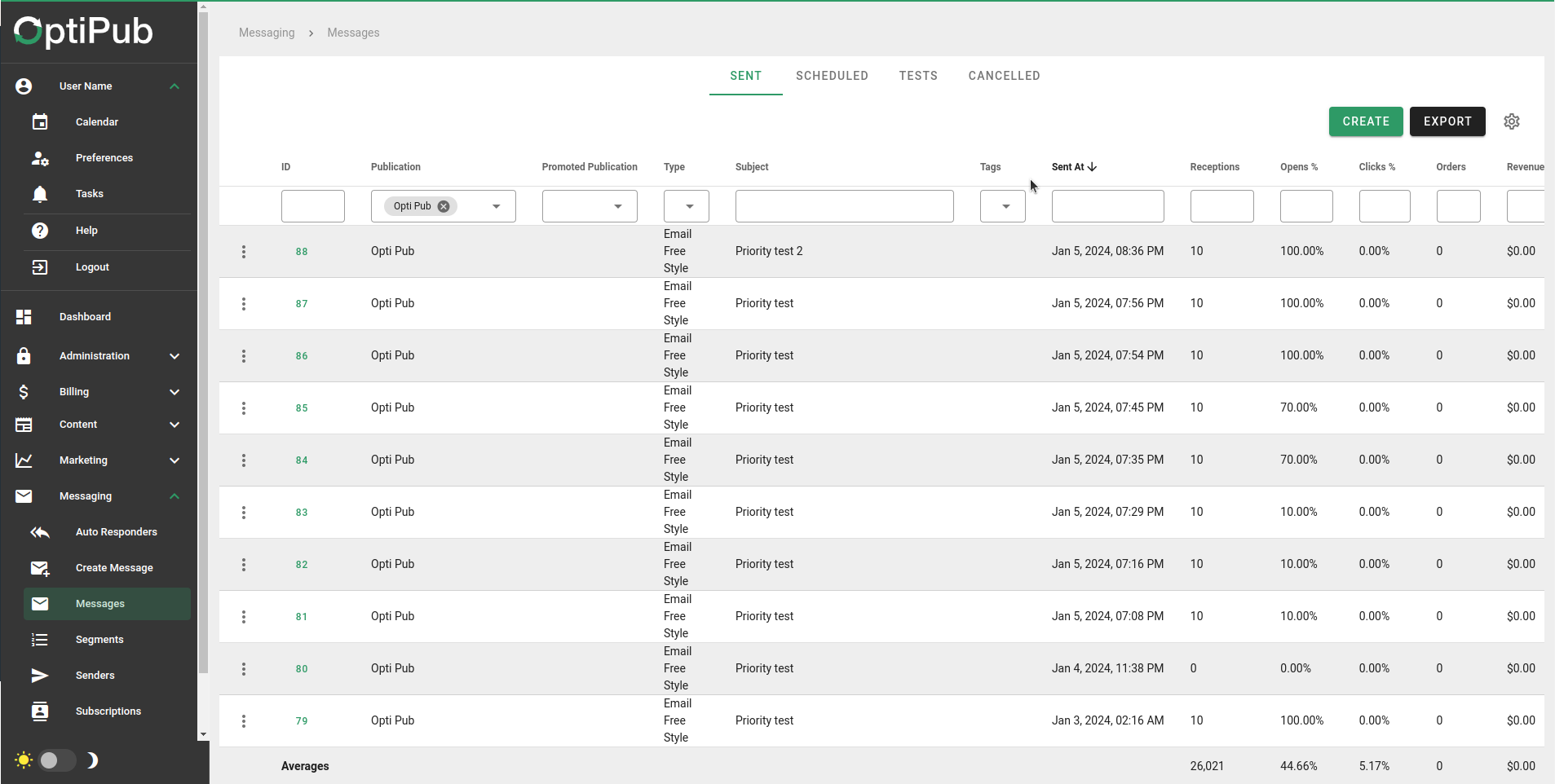
The Messages page.
Messages cannot be deleted once created. Canceled messages are filed in the Canceled column.
Exporting Messages
Click the grey Export button to export message data.
Create a Message
Navigate to Messaging > Create Message to open the 3-step wizard. OptiPub supports both email and SMS channels.
Step 1 — Configure & Recipients
| Field | Required | Description |
|---|---|---|
| Channel | Yes | Choose Email or SMS. |
| Test Message | No | Toggle on to send to a test list instead of segments. |
| Publication | Yes | The publication this message belongs to. |
| Name | Yes | An internal name for the message. |
| Send Time | Yes | Immediately or Later (pick a date and time). Hidden for test messages. |
| Content Type (Email) | Yes | Article, Lift Letter, or Free Style (if enabled). |
| Binding (Email) | No | Preselected with the publication's sending IP binding. Change it only if this message should send from a different binding. |
| Triggered Send (Email) | No | Send an auto responder to each subscriber who opens or clicks the message. See Triggered Sends on Messages. |
| Messaging Service (SMS) | Yes | Select the SMS messaging service to use. |
| Included Segments | Yes (live) | Segments to send to. Required for non-test messages. |
| Excluded Segments | No | Segments to exclude from the send. |
For test messages, enter email addresses or phone numbers directly instead of selecting segments.
Step 2 — Content
Email messages:
- Select a Template for the email layout.
- Choose the From sender and Reply To sender.
- Write a Subject line and optional Preview text.
- Compose the message body using the content editor.
- If the article and template are translated, pick the Languages to send in (see Sending in multiple languages).
- For split tests, configure 2–4 variants with sample sizes and winning criteria.
SMS messages:
- Write the message content (up to 500 characters).
Step 3 — Confirm
Review the summary of your message, recipients, and schedule, then click Send.
Sending in Multiple Languages
When translations are enabled, an Article or Lift Letter message can go out in every language its resource and template have been translated into. Each subscriber receives the version that matches the language recorded on their email address.
Choosing languages
A Languages row appears in the Content card once you have selected a template and an article, listing every language that both the article and the template exist in. To offer another language, translate the resource and the template first.
- Every available language is selected by default. Click a language chip to remove it or add it back.
- Your installation's default language is always sent and cannot be deselected.
- A language switcher appears above the preview. Use it to review and adjust the Subject, Preview text, Gmail Annotation, and body for each language independently.
- Changing the template or article reloads every language from the translated content, discarding any per-language edits.
Who receives which version
At send time OptiPub divides the included audience (minus any excluded segments) by language:
| Subscriber's language | Receives |
|---|---|
| Matches a selected language | That language's version. |
| Not selected, unsupported, or not recorded | The default language version. |
In Step 1, the recipient count next to your segments is broken down by language whenever the audience spans more than one, so you can see how many subscribers each version will reach before sending.
Each language is delivered as its own mailing. After sending, the message page lists one entry per language — or per variant and language for a split test, such as A · Español — with its own stats, and the parent message rolls them up.
Test messages
Test messages behave like a real send. Each test address receives the version for the language recorded on it; addresses OptiPub does not know, or with no recorded language, receive the default. With two variants and two test addresses, each address gets one email per variant, in its own language.
Limitations
- Free Style messages and SMS messages cannot be translated.
- Split tests with a fixed split (each variant has its own Amount) support languages per variant. Reactive splits, which pick a winner from a sample, do not: switching a split test to reactive clears its languages.
Updated about 1 month ago